

Wisconsin Biohealth Tech Hub builds partnerships to meet workforce demand
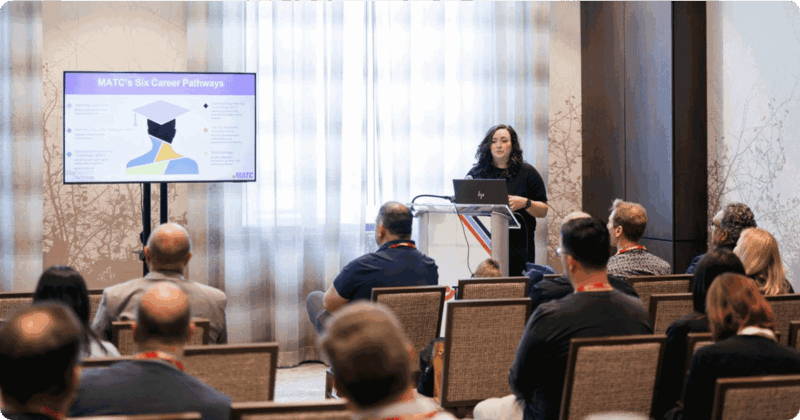
Abigail Cannon, PhD, Director of Biohealth Career Pathways, MATC, presents at the 2026 Summerfest TECH conference. Photograph: Frank Carmona Ramírez
Ensuring the continued strength of Wisconsin’s biohealth sector requires filling a growing demand for laboratory and health care technicians, and educational and workforce development officials are working together to get the job done.
A session at the recent Summerfest Tech event described how funding through the Wisconsin Biohealth Tech Hub is being used for programs that introduce young people and adults to real-life industry experiences and is helping them access the training needed to build successful biohealth careers.
Through youth programs, apprenticeships, and university and technical school training, students are being exposed to laboratory and health care skills and discovering the opportunities they provide.
“We need to train our students with some of the best equipment—and with some of the best educators—that we can,” said Sheldon Garrison, program chair of biotechnology at the Milwaukee Area Technical College (MATC) . “We need to connect them with employers. We need to connect them if they want to continue their education so that they can move on to a four-year college.”
Biohealth tech hub gathers momentum
The U.S. Economic Development Administration granted $49 million in Phase 2 funding to the Wisconsin Biohealth Tech Hub, an initiative to position Wisconsin as a global leader in personalized medicine.
The dividends from these programs are clear, officials say, as growth in the biohealth sector requires a pipeline of trained workers.
“Ultimately these graduates will strengthen our workforce in the state of Wisconsin and meet the needs of employers so that we can continue to build our precision medicine and biohealth ecosystem within the state of Wisconsin,” Garrison said.
MATC created a two-year associate degree program in biotechnology that gives students hands-on laboratory experience with instructors experienced in the field. Some, Garrison said, finish the program in one year.
“In our very first semester, they start with their LinkedIn page,” Garrison said. “We start off thinking about ‘How do I get hired? How do I highlight my skills for employers?’ We also get them their first publication.”
Building the workforce of the future
At the University of Wisconsin-Milwaukee, 10 high school graduates and university students were chosen last year, and 21 this year, for a summer program called RE-CHARGE STEM . They each received a $2,000 stipend for the seven- to eight-week program teaching about laboratory work.
Alexander Arnold, director of the Milwaukee Institute for Drug Discovery at UW-Milwaukee, said RE-CHARGE STEM is for high school graduates and college students planning the enter the local workforce as lab technicians in a variety of industries.
“We show participants what lab technicians in Wisconsin are actually doing, give them first-hand information about job categories, connect them with potential employers, familiarize attendees with different job sectors, and enable industry partners to use this program,” he said.
Other programs are working collaboratively with workforce organizations and state workforce development officials to provide similar opportunities to support the biohealth sector. They include:
- Employ Milwaukee has joined forces with MATC and Milwaukee Public Schools to provide a six-week biohealth program upcoming high school juniors and seniors. They receive instruction from MATC faculty, visit local employers, learn about careers in the field, and receive high school credit.
- Another program is being piloted in Madison this summer, a collaboration among Madison College, the Madison Metropolitan School District, and the Workforce Development Board of South Central Wisconsin. It includes a two-week biohealth summer program for 20 youths who will take part in a Madison College biotech seminar program and receive technical college credit.
- Madison College is also offering associate degree programs with training in radiography and as a medical lab technician, biotech lab technician, and biomedical equipment technician.
Officials emphasized the importance of aligning curricula to meet evolving industry needs, engaging employers in devising pipeline solutions, and developing customized workforce strategies.
Alberto Rodriguez, program director for the electrical engineering technology department at Madison College, said the school has developed an apprenticeship program for biomedical equipment technicians. The program was designed with the help of industry partners, including GE Healthcare.
“It’s a two-year apprenticeship, 23 credits, and 4,000 hours of clinical experience,” Rodriguez said. “That means you can start your job right away and start earning while you’re training. The Biohealth Tech Hub is going to pay tuition for people who are taking these classes, which eliminates another barrier to entry.”
Legal Disclaimer:
EIN Presswire provides this news content "as is" without warranty of any kind. We do not accept any responsibility or liability for the accuracy, content, images, videos, licenses, completeness, legality, or reliability of the information contained in this article. If you have any complaints or copyright issues related to this article, kindly contact the author above.
